Guide · · 5 min read
Wheat Flour Specifications Explained: Protein, Gluten, Ash and Flour Types
What each line on a flour spec sheet means, how Turkish, French, German and US flour types compare, and how to write a specification for an order or tender.
A flour spec sheet is a short document with a lot of meaning packed into it. For a buyer, it is the main tool for comparing suppliers, checking that a delivered lot matches what was agreed, and explaining to a bakery why one flour behaves differently from another.
This article explains the most common wheat flour specifications, how the main national flour type systems work, and how to turn your requirements into a specification you can put into a tender or a purchase order.
Chemical parameters: protein, gluten, moisture and ash
Protein
Protein content is the first number most buyers look at. Higher protein generally means a stronger flour that can hold gas through long fermentation, which suits bread. Lower protein suits cakes and cookies, where tenderness matters more than structure. Always check the basis: protein can be expressed on dry matter or at a fixed moisture, and the two are not directly comparable.
Wet gluten and gluten index
Wet gluten measures the gluten-forming proteins washed out of the dough. The gluten index adds information on gluten quality: whether the network is strong and elastic or weak and extensible. Two flours with the same protein can behave very differently if their gluten quality differs.
Moisture
Moisture affects shelf life and how much dry matter you are actually paying for. Lower moisture helps storage stability, which matters for long sea journeys and hot climates.
Ash
Ash is the mineral residue left after burning a sample. It indicates how much of the outer layers of the grain ended up in the flour: low ash means a whiter, more refined flour; higher ash means a darker flour with more bran particles. Many flour type systems are built on ash.
Enzyme activity and dough behaviour
Falling number
The falling number test measures alpha-amylase activity, an enzyme that breaks down starch. A very low value suggests high enzyme activity, often linked to sprouted grain, and can lead to sticky dough and a gummy crumb. A very high value means little enzyme activity, and millers or bakers may correct it. The right range depends on the product and the process.
Farinograph: water absorption and stability
The farinograph records dough resistance during mixing. It gives water absorption (how much water the flour takes to reach a standard consistency), development time and stability. For bakeries, water absorption has a direct commercial meaning: higher absorption means more dough from the same sack.
Alveograph: W value and P/L
The alveograph blows a dough sheet into a bubble until it bursts. The W value expresses the energy needed, a common indicator of flour strength. The P/L ratio describes the balance between tenacity (P) and extensibility (L). A high P/L means the dough resists stretching; a low P/L means it stretches easily. Flatbreads and phyllo typically need good extensibility, while long-fermented breads need more strength.
Granulation
Particle size affects water uptake, mixing behaviour and texture. Some products, such as certain pastries and pasta-type doughs, are sensitive to granulation.
Flour type systems compared
Different countries classify flour in different ways, which often confuses buyers comparing offers from several origins.
- Turkey: the Turkish Food Codex communiqué on wheat flour classifies flours mainly by ash on a dry-matter basis, using type numbers such as Type 550, Type 650 and Type 850, alongside special-purpose flours.
- France: the T number reflects ash. T45 is the most refined pastry flour, T55 is the classic baguette and pastry flour, T65 is used for traditional and country-style breads, and T80, T110 and T150 move toward wholemeal.
- Germany: the type number is the milligrams of ash per 100 g of flour dry matter. Type 405 is a very white flour for cakes, Type 550 is the standard bread roll flour and Type 1050 is darker and used for mixed and rustic breads.
- United States: flours are named by use and protein rather than ash: all-purpose flour sits in the middle, bread flour has higher protein, cake and pastry flours lower.
| Rough use | France | Germany | US style |
|---|---|---|---|
| Cakes, fine pastry | T45 | 405 | Cake / pastry flour |
| White bread, rolls | T55 | 550 | All-purpose / bread flour |
| Darker, rustic bread | T80 to T110 | 1050 | High-extraction / wholemeal blends |
These are approximate matches only. A type number says a lot about refinement, but little about gluten strength: two T55 flours can range from soft to strong. That is why a type name alone is never enough for an order.
How to write a flour specification for a tender or order
A good specification is short, measurable and tied to your product. Include:
- Intended use and process (for example, machine lavash on a continuous line).
- Key parameters with ranges, not single numbers: protein, wet gluten, moisture, ash, falling number, water absorption and, if relevant, W and P/L.
- Test methods you expect, so results from different laboratories are comparable.
- Packaging: sack size, sack type, labelling language and lot number on each sack.
- Documents: analysis report per lot, certificate of origin and anything your authorities require.
- Tolerance and claims procedure: what happens if a lot falls outside the range.
Avoid copying a specification from another country's flour without checking it. A spec built for a European baguette may not suit a Middle Eastern flatbread line.
Spec sheets for Hakka Lonca flours
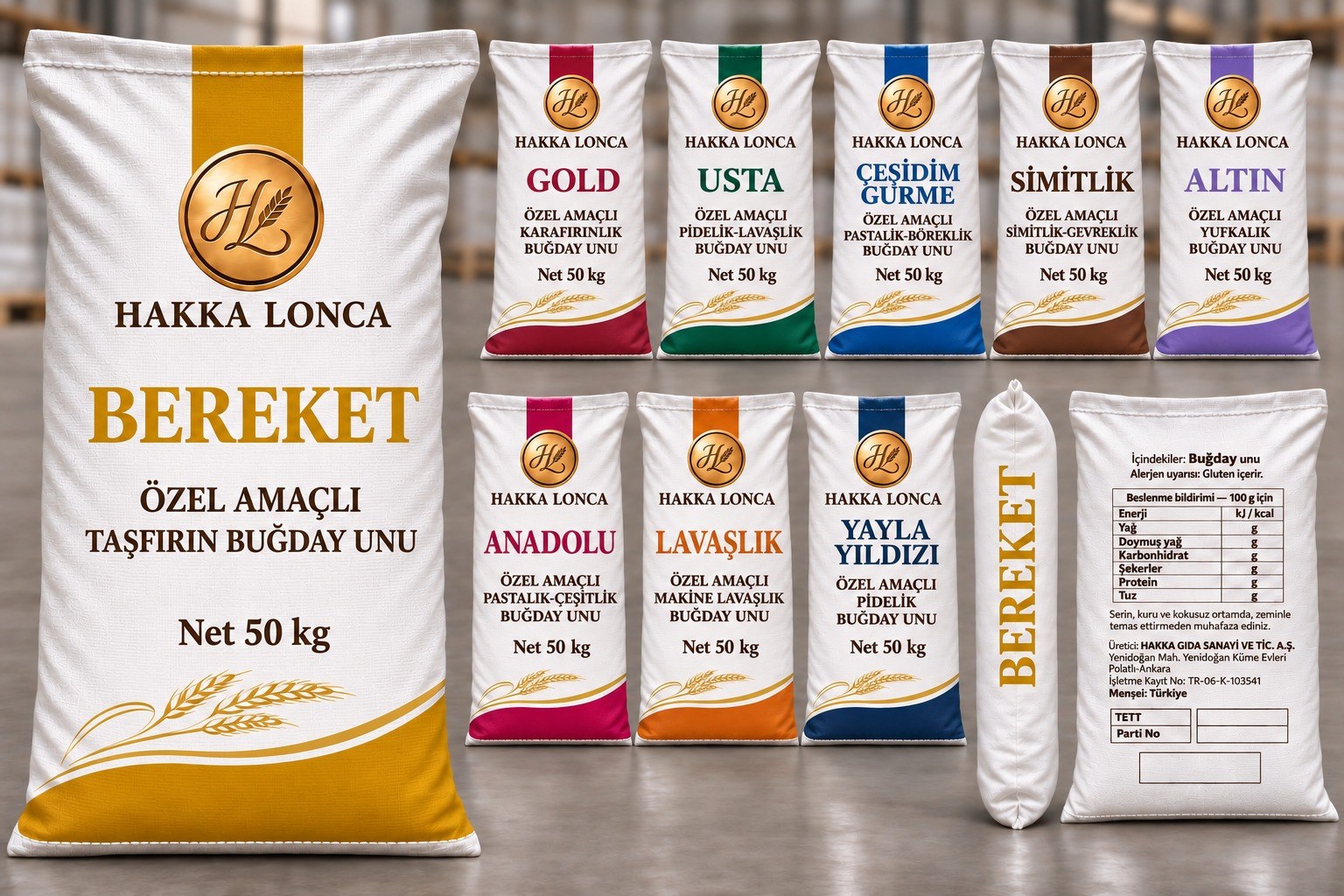
ARLAS Global Food exports the Hakka Lonca range: nine special-purpose flours in 50 kg sacks and three 2 kg retail flours. Before dispatch, the flours are checked for protein and gluten, moisture, ash, water absorption and dough resistance. We do not publish fixed values on the website; spec sheets and analysis values are shared at quotation stage, matched to the flour and use you are asking about. Send us your specification and we will tell you which flour fits.
Frequently asked questions
Is a higher protein flour always better?
No. Higher protein suits bread and long fermentation, while cakes, cookies and some pastries need lower protein for a tender result.
What is the Turkish equivalent of French T55 flour?
Turkish types are also based on ash, and Type 550 is roughly comparable in refinement. Gluten strength can still differ, so compare the full spec sheet rather than the type name.
What does the W value tell me?
W from the alveograph indicates flour strength: the energy needed to inflate a dough bubble until it bursts. It is read together with P/L, which shows the balance between tenacity and extensibility.
Why do spec values differ between laboratories?
Methods, moisture basis and equipment differ. State the test methods in your specification so that results can be compared fairly.
By ARLAS Global Food · Updated: